


Page 11 - new final magazine big size september 2025
P. 11
Problem Identification through Survey Research


             To establish the universality and social relevance of the problem, a structured survey was conducted
             among 250 residents and 10 plant nurseries using a questionnaire focusing on gardening practices,
             plastic usage, disposal methods, and environmental awareness. Data analysis revealed wide-
             spread dependence on black plastic polythene in nurseries. While nursery owners acknowl-
             edged environmental concerns, they  cited the lack of viable  alternatives.  Most respondents
             expressed readiness to adopt biodegradable solutions if affordable, confirming the need for
             sustainable intervention.

                                                                           Innovation: Shell Eco

                                                                           Pottery Bio-Pots


                                                                            The solution emerged in the form
                                                                            of biodegradable bio-pots named
                                                                            Shell Eco Pottery, made completely
                                                                            from waste materials with peanut
                                                                            shell as the major ingredient.
                                                                            Peanut shells were selected due to
                                                                            their abundance, biodegradability,
                                                                            and nutrient value. Other natural
                                                                            ingredients were carefully chosen
                                                                            to improve soil fertility,  ensure
                                                                            slow nutrient  release, remain
                                                                            pest-free, and maintain stability. A key
                                                                            feature is direct transplantability—the
             pot along with the plant can be placed directly into permanent soil, eliminating plastic waste
             and enriching the soil as it decomposes.


             Experimental Design and Methodology

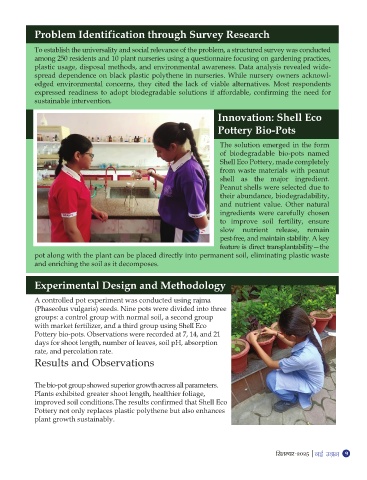
             A controlled pot experiment was conducted using rajma
             (Phaseolus vulgaris) seeds. Nine pots were divided into three
             groups: a control group with normal soil, a second group
             with market fertilizer, and a third group using Shell Eco
             Pottery bio-pots. Observations were recorded at 7, 14, and 21
             days for shoot length, number of leaves, soil pH, absorption
             rate, and percolation rate.
             Results and Observations


             The bio-pot group showed superior growth across all parameters.
             Plants exhibited greater shoot length, healthier foliage,
             improved soil conditions.The results confirmed that Shell Eco
             Pottery not only replaces plastic polythene but also enhances
             plant growth sustainably.


                                                                                               flrEcj -2025  ubZ mM+ku  9

