


Page 34 - new final magazine big size september 2025
P. 34
Science Meets Society

              What makes this book remarkable is
              its seamless integration of science,
              governance, and social insight.
              Bhagat-Ganguly deftly explains
              complex environmental chemistry
              and toxicology without losing
              sight of the people behind the
              problem.


              She sheds light  on  sustainable
              recovery technologies such as
              material recycling and metal
              extraction.

              .
              “Let our progress be circular—where today’s waste becomes tomorrow’s resource.”

              Policies, People, and Progress

              One of the book’s strongest sections is its deep dive into India’s policy evolution—from early
              guidelines to the E-Waste (Management) Rules, 2016 and 2022. The author highlights how policies
              have matured to include Extended Producer Responsibility (EPR), urging manufacturers to take
              ownership beyond the point of sale. The book also critiques implementation gaps and offers
              constructive solutions such as digital tracking systems and awareness drives.
              .
               E-Waste Policy Ecosystem – Government → Producers → Consumers → Recyclers → Environment


              Circular Economy: A Hopeful Future

                                                                                Chapter         4,     “Treating
                                                                                E-Waste:


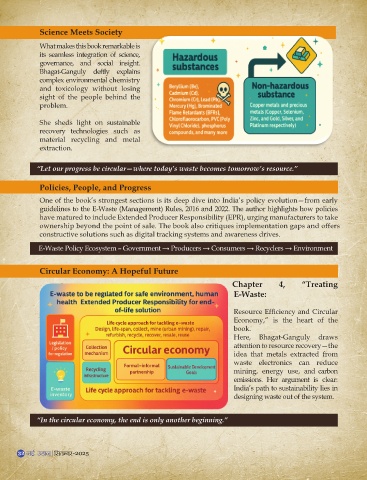
                                                                                Resource Efficiency and Circular
                                                                                Economy,”  is the heart of the
                                                                                book.
                                                                                Here, Bhagat-Ganguly  draws
                                                                                attention to resource recovery—the
                                                                                idea that metals extracted from
                                                                                waste electronics can reduce
                                                                                mining,  energy use,  and carbon
                                                                                emissions. Her argument  is clear:
                                                                                India’s path to sustainability lies in
                                                                                designing waste out of the system.

              .
              “In the circular economy, the end is only another beginning.”


       32  ubZ mM+ku flrEcj
                          -2025

